Blast from the Past – South Davis Library – Bountiful
Book us for your next event! Our library consists of some of the most iconic, classic chart along with new original pieces written or arranged by members of the group. Whatever your tastes we are sure to bring a touch of class at a very reasonable price.
Who are the Rhythm Red Devils? We are a community jazz band based in Davis County comprising of both seasoned musicians with over 50 years of big band performance and promising high school students. The goal is to allow younger musicians that have a passion for music to experience playing side by side with some of the finest musicians in the community. Due to this mix of experience sometimes we experience what can only be described as a train wreck, but this is part of the learning process too.
Here are your Rhythm Red Devils
Reeds
Doug Bailey – Alto Sax/Clarinet/Flute/Director David Irvine – Alto Sax Jon Coombs – Flute/Tenor Sax Dale Reese – Tenor Sax Matthew Bailey – Baritone Sax
Aaron “Oz” Ozminski Mike Nybo Zach Allred Parker Zollinger
Rhythm
Nick Moss – Piano Craig Nybo – Bass Rob Griffin – Guitar Keith Moon – Drums
Vocals
Dane Anderson Kori Robbins
Here is the playlist
1 007
Audio Example: NOTE: You CAN play along with this example. Midi from the MuseScore file
Written by: Monte Norman & John Barry
Arranged by: James H. & Doug B.
Page Number: New
Book Number: Red Folder
Beats Per Minute: ♩ = 135
Key Signature: G Minor
The "James Bond Theme" is the main signature theme music of the James Bond films and has been used in every Bond film, starting with Dr. No in 1962. The piece, composed in E minor[1] by Monty Norman, has been used as an accompanying fanfare to the gun barrel sequence in every Eon Productions Bond film except Casino Royale (played fully, instead, at the end of that film).
The "James Bond Theme" has accompanied the opening titles twice, as part of the medley that opens Dr. No and then again in the opening credits of From Russia with Love. It has been used as music over the end credits for Dr. No, Thunderball, On Her Majesty's Secret Service, The World Is Not Enough, Casino Royale, Quantum of Solace, Skyfall, and Spectre. In 2008, the original recording of "The James Bond Theme" by The John Barry Seven And Orchestra on the United Artists label was inducted into the Grammy Hall of Fame.[2]
Authorship and origin
Monty Norman wrote and composed the "James Bond Theme" and received royalties from 1962 until his death in 2022. Norman collected around £600,000 in royalties between 1976 and 1999.[3] For Dr. No, Norman scored the film and the theme was arranged by John Barry, who would later go on to compose the soundtracks for eleven James Bond films. Courts have ruled that the theme was written by Norman, despite claims and testimony by Barry that he had actually written the theme. Norman consequently won two libel actions against publishers for claiming that Barry wrote the theme, most recently against The Sunday Times in 2001.[3]
Norman describes the distinctive rhythm of the guitar in the first few bars of the "James Bond Theme" as "Dum di-di dum dum". He said that it was inspired by "Bad Sign, Good Sign", a song he composed for a musical adaptation of V. S. Naipaul's novel A House for Mr Biswas, set in the Indian community in Trinidad. Norman showed his manuscript music from A House for Mr Biswas in a filmed interview and sang its lyrics. In 2005, Norman released an album called Completing the Circle that features "Bad Sign, Good Sign", the "James Bond Theme", and a similar-sounding song titled "Dum Di-Di Dum Dum". For these songs Norman added lyrics that explain the origin and history of the "James Bond Theme".[4][better source needed]
Although the "James Bond Theme" is identified with John Barry's jazz arrangement, parts of it are heard throughout Monty Norman's score for Dr. No in non-jazzy guises. Barry's arrangement is repeated ("tracked") in various scenes of the first Bond film. This is consistent with the account given by Barry and some of the film-makers, contained in supplementary material on the DVD release of Dr. No: Barry was called in to make an arrangement of Norman's motif after Norman had completed the score. The origins of the distinctive ostinati, countermelodies, and bridges introduced by Barry that are juxtaposed with Norman's motif in order to flesh out the arrangement are less clear. These added musical figures have become as recognizable to listeners as Norman's motif, which is probably responsible for the controversy over the authorship of the "James Bond Theme" as listeners have come to know it.[citation needed]
On 21 June 1962 (63 years ago), the "James Bond Theme" was recorded using five saxophones, nine brass instruments, a solo guitar, and a rhythm section.[5] The guitar motif heard in the original recording of the theme was played by Vic Flick on a 1939 English Clifford Essex Paragon Deluxe guitar plugged into a Fender Vibrolux amplifier. Flick was paid a one-off fee of £6 (equivalent to £160 in 2023) for recording the famous "James Bond Theme" motif.[6]John Scott played the saxophone. Barry, who was paid £250 for his work (equivalent to £6,740 in 2023), was surprised that his theme appeared so often in Dr. No. He was told by Noel Rogers, the head of United Artists Music, that although the producers would not give him any more money or a writing credit, they would get in touch with him if another Bond film were made.[7]
Use in the James Bond films
Within the Bond films themselves, many different arrangements of the theme have been used, often reflecting the musical tastes of the specific times. The electric guitar version of the theme is most associated with the Sean Connery era although it was also used in some Roger Moore films, in Timothy Dalton's final film Licence to Kill and in the Bond films starring Pierce Brosnan and Daniel Craig with the arrangement by David Arnold.
For every Bond movie which John Barry scored, he orchestrated a slightly different version of the Bond theme, as can be heard during the gun barrel sequence. These specialised Bond themes often reflected the style and locations featured in the movie, and the actor playing Bond.
The "James Bond Theme" and its variations found in the movies are played during many different types of scenes. Early in the series, the theme provided background music to Connery's entrances. It was not until Goldfinger in 1964 that John Barry began to use the theme as an action cue. Since then, the primary use of the "James Bond Theme" has been with action scenes.
Sean Connery (1962–1967)
The first appearance of the "James Bond Theme" was in Dr. No. There it was used as part of the actual gun barrel and main title sequence. It was also used when James Bond first introduces himself.
In From Russia with Love, the "James Bond Theme" appears not only in the gun barrel pre-title sequence, but as part of the main title theme and in the track "James Bond with Bongos". It is a slower, jazzier, somewhat punchier rendition than the original orchestration. The original Barry arrangement from Dr. No is heard during a check of Bond's room for listening devices.
In Goldfinger, the "James Bond Theme" can be heard on the soundtrack in "Bond Back in Action Again" (gun barrel and pre-title sequence). The "James Bond Theme" for this movie is heavily influenced by the brassy, jazzy theme song sung by Shirley Bassey.
Thunderball used a full orchestral version of the theme in the track "Chateau Flight". Another full orchestral version was intended for the end titles of the film.
You Only Live Twice had a funereal orchestration with Bond's "burial" at sea sequence in Hong Kong harbour. A full orchestral version of the theme was used in the Little Nellieautogyro fight scene.
George Lazenby (1969)
The George Lazenby film On Her Majesty's Secret Service used a unique high-pitched arrangement with the melody played on a Moog synthesizer. The cue is called "This Never Happened to the Other Feller" and a similar recording was used over the film's end credits. The film has a downbeat ending and the explosive burst of the "James Bond Theme" at the film's very end suggests Bond will return in spite of the situation he finds himself in at the climax of this movie.
Sean Connery (1971)
With the return of Sean Connery in Diamonds Are Forever, the guitar made a comeback along with a full orchestral version during a hovercraft sequence. On the soundtrack, this track is named "Mr. Wint and Mr. Kidd/Bond to Holland."
Roger Moore (1973–1985)
When Roger Moore came to the role, the "James Bond Theme" became a string orchestra driven piece. In Live and Let Die, the James Bond theme was featured in a funk-inspired version of the tune reflecting the music of Blaxploitation films popular at the time.
The brief quote of the theme in the pre-credits music of The Spy Who Loved Me, titled "Bond 77", featured a disco sound, reflecting a style of music which was very popular at the time. The Spy Who Loved Me returned briefly to using the surf-rock guitar associated with the theme from the early days.
One unusual instance occurred in Octopussy, when Bond's contact Vijay (Vijay Amritaj), who is disguised as a snake charmer, plays a few notes of the tune for Roger Moore's James Bond, presumably as a pre-arranged identification signal. This is an example of the tune being used as diegetic music.
In Moore's last Bond film, A View to a Kill, the melody of the theme was played on strings.
Timothy Dalton (1987–1989)
The first Bond film with Timothy Dalton, The Living Daylights, which was the last Bond film scored by Barry, used a symphonic version with the melody played on strings. This version of the Bond theme is notable for its introduction of sequenced electronic rhythm tracks overdubbed with the orchestra – at the time, a relatively new innovation.
In Licence to Kill, the Bond theme was arranged by Michael Kamen using rock drums to symbolise a harder and more violent Bond. This gun barrel is the first one since Dr. No not starting with the Bond theme, but orchestral hits though the surf guitar makes returns soon after.
Pierce Brosnan (1995–2002)
The gun barrel of the Pierce Brosnan film GoldenEye opened with a synthesised arrangement by Éric Serra which plays the guitar riff on (almost indistinct) kettle drums. A more traditional rendition by John Altman is heard in the film during the tank chase in St. Petersburg. This version of the "James Bond Theme" is not included in the GoldenEye soundtrack. Additionally, Starr Parodi composed a version of the "James Bond Theme" for the 1995 trailer.[8]David Arnold's gun barrel arrangements in Tomorrow Never Dies and The World Is Not Enough dropped the guitar melody line, jumping straight from the tune's opening to its concluding bars. An electronic rhythm was added to the gun barrel of The World Is Not Enough. The typical Bond guitar line can be heard during some action scenes.
The Die Another Day gun barrel recalls the version of From Russia with Love but with a more techno-influenced rhythm. It also contains the guitar riff of the "James Bond Theme".
Daniel Craig (2006–2021)
Daniel Craig's first James Bond film, Casino Royale, does not feature the "James Bond Theme" in its entirety until the very end of the movie during a climactic scene. In Casino Royale, the main notes of the song "You Know My Name" are played throughout the film as a substitute for the "James Bond Theme". A new recording of the classic theme, titled "The Name's Bond…James Bond", only plays during the end credits to signal the beginning of the character's new arc as the 21st century version of James Bond. Although that is the first time the theme is played in its entirety, the first bars of the song (the chord progression) appeared as a slow background music in seven moments throughout the movie: after Bond's conversation with M (Judi Dench) during his flight, after winning the Aston Martin, when he makes his first appearance in a tuxedo (accompanied by a few bars of the bridge), after he has survived the poisoned martini, when he wins the final match at Casino Royale, when Bond is following Vesper Lynd (Eva Green), and when Bond speaks with M on the phone.
At the end of Quantum of Solace, the theme appears with Craig's new official gun barrel sequence, unusually shown at the end of the film. The theme here is very similar to the classic style in Casino Royale. It appears sparingly throughout the score itself, never in an immediately recognizable variation. David Arnold said in an interview on the DVD extras for Tomorrow Never Dies that the "James Bond Theme" is what he expects to hear as an audience member in action scenes, yet his scores for Casino Royale and Quantum of Solace only use it during the end credits.
The next film, Skyfall, includes the theme as part of the harmony to Adele's vocals during the title theme "Skyfall" and is used as the chord progression, including a faint surf guitar riff. Also, in a similar way to Quantum of Solace, the gun barrel sequence is shown at the end of the film. The theme that plays along with the sequence and into the end credits is David Arnold's Casino Royale track "The Name's Bond…James Bond". Despite this, the film's score was composed by Thomas Newman, who also incorporated the "James Bond Theme" throughout the entire film.
In Spectre, the theme appears at the beginning of the film as part of the opening gun barrel sequence, indicating a return to the franchise's classic era of 1962 to 2002.
The theme is used again in No Time to Die, in the tracks named "Gun Barrel" and "Back to MI6". A reworked, salsa-like version was used in "Cuba Chase". This is the only film in the Craig era that doesn't use the Bond theme in the credits, instead using "We Have All the Time in the World" from On Her Majesty's Secret Service. This is because of Bond's death at the end of the film. Additionally, the film's title track performed by Billie Eilish features a single trumpet solo interpolating the theme.
Chart performance
The John Barry Orchestra recording peaked at number eleven on the UK Singles Chart on the week of 6–12 December 1962.[9]
Cover versions
Apart from the James Bond soundtracks themselves, John Barry re-recorded the "James Bond Theme" in 1966 for his CBS album The Great Movie Sounds of John Barry, which features driving percussion ostinati (with a prominent role for bongos), as well as a piano and brass improvisation superimposed over the last few bars.[10] For his 1972 Polydor album The Concert John Barry, he re-scored the theme again as part of a James Bond suite for full symphony orchestra, in this case the Royal Philharmonic Orchestra.[11] This more lush arrangement was to feature in his later Bond film scores, notably Octopussy.
Monty Norman recorded his own version of the "James Bond Theme", shorn of Barry's orchestration, in his 2005 album Completing the Circle.[12]
Over 70 cover versions of the "James Bond Theme" have been recorded by artists such as:
Audio Example: NOTE: You CAN play along with this example. Midi from muse score: Slower practice MP3 can be found at: https://rhythmreddevils.com/wp-content/uploads/2025/09/Circus-Freak-SLOW-PRACTICE-120bpm.mp3
Year: 2025
Written by: Griffin Gillen
Arranged by: Doug Bailey
Page Number: New
Book Number: Red Folder
Beats Per Minute: ♩ = 174
Key Signature: Fm
Time Signature: 4/4
This song was originally written with only Clavier, Hammond Organ, and rhythm section. This arrangement is unique for Rhythm Red Devils.
3 720 In The Book
Audio Example: NOTE: You CAN play along with this example.
Year: 1939
Written by: Harold Adamson, Jan Savitt, & Johnny Watson
Arranged by: Jack Mason
Page Number: 720
Book Number: 1
Beats Per Minute: ♩ = 145
Time Signature: 4/4
What's the tune they like the best
When the jive becomes de-luxe
What's the number one request
Seven-twenty in the books
When the band begins to play
You should see the dirty looks
If the leader doesn't say
Seven-twenty in the books
It's something that you'll approve
Gets you right in the groove
To keep in step
You really gotta be hep
Just be like the kangaroo
Or the fishes in the brooks
Ev'rybody's jumpin' to
Seven-twenty in the books
4 Fly Me To The Moon
Audio Example: NOTE: You CAN play along with this example.
Year: 1954
Written by: Bart Howard
Arranged by: Sammy Nestico
Page Number: 17
Book Number: 1
Beats Per Minute: ♩ = 112
Key Signature: Ab
Time Signature: 4/4
"Fly Me to the Moon", originally titled "In Other Words", is a song written in 1954 by Bart Howard. The first recording of the song was made in 1954 by Kaye Ballard. Frank Sinatra's1964 version was closely associated with the Apollo missions to the Moon.
In 1954, when he began to write the song that became "Fly Me to the Moon", Bart Howard had been pursuing a career in music for over 20 years, Howard wrote the song for his partner of 58 years, Thomas Fowler.[2] He played piano to accompany cabaret singers, but also wrote songs with Cole Porter, his idol, in mind.[3] In response to a publisher's request for a simpler song,[4] Bart Howard wrote a cabaret ballad[5] which he titled "In Other Words". A publisher tried to make him change some words from "fly me to the Moon" to "take me to the Moon," but Howard refused.[6]Many years later Howard commented that "... it took me 20 years to find out how to write a song in 20 minutes."[6]
He used his position as a piano accompanist and presenter at the Blue Angel cabaret venue to promote the song,[4] and it was soon introduced in cabaret performances by Felicia Sanders.[3]
The song was composed in 3/4time signature but was changed to 4/4 by Quincy Jones in his arrangement.[7][permanent dead link][citation needed]
5 Fancy Pants
Audio Example: NOTE: You CAN play along with this example.
Audio Example: NOTE: You CAN play along with this example.
Year: 1963
Written by: Carlos Jobim
Arranged by: Glenn Osser
Page Number: 19
Book Number: 1
Beats Per Minute: ♩ = 112
Time Signature: 4/4
The song was composed for a musical comedy titled Dirigível ("Airship"), then a work in progress of Vinicius de Moraes. The original title was "Menina que Passa" ("The Girl Who Passes By"); the first verse was different. Jobim composed the melody on his piano in his new house in Rua Barão da Torre, in Ipanema. In turn, Moraes had written the lyrics in Petrópolis, near Rio de Janeiro, as he had done with "Chega de Saudade" ("No More Blues") six years earlier. While firmly rooted in bossa nova, "The Girl from Ipanema" includes influences from blues and Tin Pan Alley.[9]
During a recording session in New York with João Gilberto, Antônio Carlos Jobim and Stan Getz, the idea of cutting an English-language version came up. Norman Gimbel wrote the English lyrics. João's wife, Astrud Gilberto, was the only one of the Brazilians who could speak English well and was chosen to sing. Her voice, without trained singer mannerisms, proved a perfect fit for the song.[10] However, she was never credited or received any royalties, and received only $120 for her part.[11]
The key the song is played in traditionally has varied depending upon the origin of the recording. While the original Ribeiro version was in the key of G, most Brazilian performances use D♭ and most American versions use F.[9]
Astrud Gilberto and Getz appear as themselves and perform the song in the 1964 film Get Yourself a College Girl.
Frank Sinatra recorded the song with Jobim in 1967 for their album Francis Albert Sinatra & Antônio Carlos Jobim.[12]Ella Fitzgerald recorded it for her two-disc set of Brazilian music Ella Abraça Jobim, released by Pablo Today in 1981. Ethel Ennis and Nat King Cole have also both recorded the song. A version by Gary Criss titled "The Girl From Ipanema / Brazilian Nights" from his album "Rio De Janeiro" reached number 19 in the Canadian RPM dance charts in August 1978.[13]Eliane Elias included the song in her albums Eliane Elias Sings Jobim (1998) and Brazilian Classics (2003).
Lyrics
Tall and tan and young and lovely The girl from Ipanema goes walking And when she passes, each one she passes goes "Ah!"
When she walks, she's like a samba That swings so cool and sways so gently That when she passes, each one she passes goes "Ah!"
Oh, but he watch her so sadly How can he tell her he loves her? Yes, he would give his heart gladly But each day, when she walks to the sea She looks straight ahead, not at him
Tall and tan and young and lovely The girl from Ipanema goes walking And when she passes, he smiles, but she doesn't see
Oh, but he sees her so sadly How can he tell her he loves her? Yes, he would give his heart gladly But each day, when she walks to the sea She looks straight ahead, not at him
Tall and tan and young and lovely The girl from Ipanema goes walking And when she passes, he smiles, but she doesn't see
She just doesn't see No, she doesn't see But she doesn't see
8 Killer Joe
Audio Example: NOTE: This is an example only! You CAN NOT play along with this.Original Benny Golson recording. Follow the style.
Year: 1960
Arranged by: Michael Sweeney
Page Number: 44
Book Number: 1
Time Signature: 4/4
"Killer Joe" was first released on the Jazztet's 1960 album titled "Meet the Jazztet." The composition became one of Benny Golson's most well-known and frequently performed pieces. The tune is characterized by its catchy melody and has been embraced by jazz musicians across generations.
The Jazztet's recording of "Killer Joe" features a distinctive hard bop sound and showcases the talents of the ensemble's members. Over the years, the composition has been covered by numerous artists and has become a jazz standard in its own right. Its enduring popularity is a testament to Benny Golson's skill as a composer and the timeless appeal of the piece.
9 Moonlight Serenade
Audio Example: NOTE: You CAN play along with this example.
Year: 1939
Written by: Glenn Miller
Arranged by: Glenn Miller
Page Number: 22
Book Number: 1
Beats Per Minute: ♩ = 78
Key Signature: Eb
Time Signature: 4/4
"Moonlight Serenade" is an American swing ballad composed by Glenn Miller with subsequent lyrics by Mitchell Parish. It was an immediate phenomenon when released in May 1939 as an instrumental arrangement, though it had been adopted and performed as Miller's signature tune as early as 1938, even before it had been given the name "Moonlight Serenade". In 1991, Miller's recording of "Moonlight Serenade" was inducted into the Grammy Hall of Fame.
Miller studied the Schillinger technique with Joseph Schillinger,[1] who is credited with helping Miller create the "Miller sound", and under whose tutelage he composed "Moonlight Serenade".[2]
The song evolved from a 1935 version entitled "Now I Lay Me Down to Weep", with music by Glenn Miller and lyrics by Eddie Heyman to a version called "Gone with the Dawn" with lyrics by George Simon,[3] and "The Wind in the Trees" with lyrics by Mitchell Parish. In his biography of Glenn Miller, George T. Simon recounted how vocalist Al Bowlly of the Ray Noble Orchestra sang him the Eddie Heyman lyrics to the Glenn Miller music of "Now I Lay Me Down to Weep" in 1935. The Noble Orchestra never recorded the song. Finally it ended up as "Moonlight Serenade" because Robbins Music bought the music and learned that Miller was recording a cover of "Sunrise Serenade", a Frankie Carle associated song[4] for RCA Victor. They thought "Moonlight" would be a natural association for "Sunrise".[5]
Jazz critic Gary Giddins wrote about the song's impact and legacy; "Miller exuded little warmth on or off the bandstand, but once the band struck up its theme, audiences were done for: throats clutched, eyes softened. Can any other record match 'Moonlight Serenade' for its ability to induce a Pavlovian slobber in so many for so long?" (The New Yorker, May 24, 2004).
The 1939 RCA Victor studio recording of "Moonlight Serenade" was released by the U.S. War Department as Army V-Disc 39A, VP 75, Theme Song, in November 1943. The recording was also released as the Navy V-Disc No. 160A and the Marine Corps V-Disc No. 160A. A V-Disc test pressing of a recording of the song from November 17, 1945 by the AAF Band was made but the disc was not issued. A new recording by Glenn Miller with the American Band of the Allied Expeditionary Forces (AEF) was broadcast to Germany in 1944 on the radio program The Wehrmacht Hour.
The song was recorded on April 4, 1939 on the RCA Bluebird label, and was a Top Ten hit on the U.S. pop charts in 1939, reaching number three on the Billboard charts, where it stayed for a total of fifteen weeks. It was the fifth most popular hit of 1939 in the Billboard year-end tally, where Miller had five records in the top 20.
In the UK, "Moonlight Serenade" was released as the A-side of a 78 for His Master's Voice (catalogue number B.D.5942) with "American Patrol" as the B-side. The recording reached number twelve in the UK in March 1954, staying on the chart for one week.[6][7] In January 1976 on a maxi single with "Little Brown Jug" and "In the Mood", "Moonlight Serenade" reached number thirteen on the UK charts, in a chart run of eight weeks.[7] The recording was also issued as a V-Disc in November 1943.
10 May Each Day
Audio Example: NOTE: This is an example only! You CAN NOT play along with this.
Year: 1963
Written by: George Wyle
Arranged by: Unknown
Page Number: 62
Book Number: 1
Beats Per Minute: ♩ = 73
Time Signature: 3/4
May each day in the week be a good day May the Lord always watch over you And may all of your hopes turn to wishes And may all of your wishes come true
May each day in the month be a good day May you make friends with each one you meet And may all of your daydreams be mem'ries And may all of your mem'ries be sweet
The weeks turn to months and the months into years There'll be sadness and joy, there'll be laughter and tears But one thing I pray to heaven above May each of your days be a day full of love
May each day in the year be a good day May each dawn find you happy and gay And may all of your days be as lovely As the one you shared with me today
May each day of your life be a good day And good night.
11 Tea for Two Cha Cha Cha
Audio Example: NOTE: You CAN play along with this example.
Year: 1924
Arranged by: Neil Richardson
Page Number: 89
Book Number: 1
Time Signature: 4/4
"Tea for Two" is a 1924 song composed by Vincent Youmans, with lyrics by Irving Caesar.[4][5] It was introduced in May 1924 by Phyllis Cleveland and John Barker during the Chicago pre-Broadway run of the musical No, No, Nanette.[6][4] When the show finally hit Broadway on September 16, 1925, Nanette was played by Louise Groody, and her duet with Barker of "Tea for Two" was a hit. The song went on to become the biggest success of Youmans' career.[7]
Background
Youmans had written the basic melody idea of "Tea for Two" while he was in the navy during World War I, and he used it later on as an introductory passage for a song called "Who's Who with You?" While in Chicago, Youmans developed the idea into "a song that the hero could sing to the heroine" for the musical No, No, Nanette. He soon after played his composition for Irving Caesar and insisted he write the lyrics then and there. Caesar quickly jotted down a mock-up lyric, fully intending to revise it later on. Youmans, though, loved the mock-up and convinced Caesar it was just right for the melody.[8][4]
It has been proposed, with little supporting evidence, that the phrase 'Tea for Two' was originally shouted by hawkers on the streets of 18th century England who wanted to attract business by lowering the price of a pot of tea from thruppence to tuppence. While this may be the case, 'tea for two' would have been a commonplace order for a couple in 19th-century English cafeterias.[9][10]
Musical characteristics
"Tea for Two" has an A1-A2-A3-B form, a range of just over an octave, and a major tonality throughout.[11][12] The song's original key was A♭ major with a pivot modulation to C major during the second "A" section.[11] It is rhythmically repetitive (as the entire song consists of eighth and quarter notes, except for a pattern of eighth, quarter, and eighth notes which briefly emerge in the second section) and has a relatively simple harmonic progression, as well as a simple yet charming melody.[11][12]
Charting recordings
January 1925: The Benson Orchestra of Chicago's instrumental rendition reaches number five on the US Billboard chart and stays there for five weeks.[13][9]
January 1925: Marion Harris's rendition reaches number one on the US Billboard chart and stays there for 11 weeks.[13][9]
1939: Art Tatum's rendition, for which he posthumously received a Grammy Hall of Fame Award, hits number eighteen on the US Billboard chart and stays there for a week.[13][9]
September 1958: Tommy Dorsey's rendition reaches number seven on the US Billboard chart and stays there for twenty weeks and number five on the weekly top 50 charts from the Toronto radio station 'CHUM' and stays there for thirteen weeks.[13][9]
October 1958: Tommy Dorsey's rendition reaches number three on the UK Singles chart and stays there nineteen weeks.[13][9]
Adaptations and notable covers
In 1926, Boris Fomin arranged it for inclusion in his operetta "The Career of Pierpont Blake" (Карьера Пирпойнта Блэка), with Russian lyrics by Konstantin Podrevsky, under the title "Tahiti Trot".[14]
In 1927, Dmitri Shostakovich arranged "Tea for Two", known in the Soviet Union as Tahiti Trot, from memory after conductor Nicolai Malko bet him he could not do it in under an hour. He completed the orchestration in 45 minutes.
The following artists covered the song: Benny Goodman (1937), Fats Waller (c. 1938–1939), Gene Krupa with Anita O'Day (c. 1942), Art Tatum, Stan Kenton with O'Day (1944–1945), Frank Sinatra and Dinah Shore (1947), Doris Day (1955), Duke Ellington, appearing on a 1999 expanded version of Ellington at Newport (1956), Bud Powell, The Genius of Bud Powell (1956), Teddy Wilson (1956), Anita O'Day, Anita O'Day at Mister Kelly's (1959).
In popular culture
In the 1975 documentary, Grey Gardens, Edith Ewing Bouvier Beale, or Big Edie, notoriously sings a slightly broken version the song for the Maysles brothers, as it was one of her favorite songs during her youth.
Bugs Bunny and Daffy Duck soft-shoe to “Tea for Two” in the Looney Tunes short Show Biz Bugs.
The song features prominently in the novel La invención de Morel (1940) by Argentine writer Adolfo Bioy Casares.
In the French–British WWII-set comedy film La Grande Vadrouille (1966) the humming of the "Tea for Two" melody is the secret code for the British bomber crew members to recognise each other in the Turkish baths at the Grand Mosque of Paris.
Occasionally on The Tonight Show Starring Johnny Carson, if a joke bombed during his monolog, the band would play "Tea for Two" and Carson would do a short soft shoe dance, which always got a laugh from the studio audience.
The pianist Yuja Wang will play "Tea For Two" as an encore, after, for example, playing all four Rachmaninov piano concertos at a concert.
The song is featured on The Offspring's 1997 album Ixnay on the Hombre, in the form of the track "Intermission."
12 Birdland
Audio Example: NOTE: You CAN play along with this example.
Year: 1977
Written by: Joe Zawinul
Arranged by: Michael Sweeney
Page Number: 31
Book Number: 1
Beats Per Minute: ♩ = 152
Time Signature: 4/4
Is a jazz/pop song written by Joe Zawinul of the band Weather Report as a tribute to the Birdland nightclub in New York City, which appeared on the band's 1977 album Heavy Weather. The Manhattan Transfer won a Grammy Award with their 1979 version of the song, which had lyrics by Jon Hendricks.[1]Quincy Jones won two Grammy Awards for the version of the piece he included on his 1989 album Back on the Block.[2] The leading Cuban band Los Van Van included an extended interpolation of the piece in their song Tim Pop/Birdland.
"Birdland" opens Heavy Weather, the 1977 album that marked the commercial peak of Weather Report's career. The composition is a tribute to the famous New York City jazz club named Birdland that operated on Broadway from 1949 through 1965 and hosted many great jazz musicians of the era. This was where Zawinul, who visited the club almost daily, heard performances by Count Basie,[3] Louis Armstrong, Duke Ellington, and Miles Davis. It was also where he met his wife, Maxine.[4] Looking back, Zawinul claimed, "The old Birdland was the most important place in my life."[5] The song was also named in honor of Charlie Parker. According to Jaco Pastorius in a 1978 interview, the studio version of the song released on Heavy Weather was recorded in just one take.[6]The Penguin Guide to Jazz Recordings comments that “Birdland” typifies the formula that made the band successful, and “is one of only a handful of contemporary jazz tunes that everyone seems to have heard.”[7]
13 Kiss of Fire
Audio Example: NOTE: You CAN play along with this example.
Year: 1952
Written by: Lester Allen
Arranged by: Glenn Osser
Page Number: 79
Book Number: 1
Beats Per Minute: ♩ = 120
Time Signature: 4/4
"El Choclo" (South American Spanish: meaning "The Corn Cob") is a popular song written by Ángel Villoldo, an Argentine musician. Allegedly written in honour of and taking its title from the nickname of the proprietor of a nightclub, who was known as "El Choclo". It is one of the most popular tangos in Argentina.
The piece was premiered in Buenos Aires in 1903 – the date appears on a program of the venue – at the elegant restaurant El Americano on Cangallo 966 (today Teniente General Perón 966) by the orchestra led by José Luis Roncallo.
"El Choclo" has been recorded (without vocals) by many dance orchestras, especially in Argentina. A number of vocal versions were recorded in the United States in 1952, but the most popular was the one by Georgia Gibbs, which reached no. 1 on the Billboard chart under the name "Kiss of Fire".[1][2]Tony Martin's version reached no. 6, Toni Arden's no. 14, Billy Eckstine's no. 16, Louis Armstrong's no. 20, and Guy Lombardo's version reached no. 30. There are Spanish versions of "Kiss of Fire" by Connie Francis and Nat King Cole. In 1953 Olavi Virta and Metro-Tytöt released a Finnish version, titled "Tulisuudelma", which means "Kiss of Fire". The Finnish words, by "Kullervo" (Tapio Kullervo Lahtinen), closely follow the English. In 2001 the hip-hop group Delinquent Habits made the song known to a new generation when they released "Return of the tres", which relies heavily on samplings from a Mariachi version of the classical tango. The latest edition to this tune is included in the 2013 production by 7 Notas Music Designers of "Red Soul" by Manee Valentine.
14 Embraceable You
Audio Example: NOTE: You CAN play along with this example.
Audio Example: NOTE: You CAN play along with this example. Bass player's nightmare, I mean dream!
Year: 1969
Written by: Pee Wee Ellis
Arranged by: Kris Berg
Page Number: 42
Book Number: 1
Beats Per Minute: ♩ = 110
Time Signature: 4/4
The Chicken is a cool jazz funk standard composed by Pee Wee Ellis, saxophonist and member of James Brown’s band in the 60s. The Chicken first appeared as a B-side of a 1969 James Brown single called The Popcorn but was later made famous by Jaco Pastorius, who made it his signature song.
16 Nice 'n' Easy
Audio Example: NOTE: You CAN play along with this example. The recording is only partially playable and omits the first 2 measures.
Year: 1960
Written by: Alan Bergman, Marilyn Bergman** (nee Keith) & Lew Spence
Page Number: 83
Book Number: 1
Beats Per Minute: ♩ = 115
Time Signature: 4/4
Nice 'n' Easy is the eighteenth studio album by Frank Sinatra, released on July 25, 1960.[3]
All the songs, with the notable exception of the title song, are sung as ballads and were arranged and conducted by Nelson Riddle. The title song was a last-minute substitute for the originally planned "The Nearness of You," which did not appear on the original LP.
The album spent nine weeks at number one on the Billboardstereo album chart, and one week at number one on the corresponding mono album chart.[4] At the 1960 Grammy Awards, Nice 'n' Easy was nominated for the Grammy Award as Album of the Year, Best Male Vocal Performance, Best Arrangement. The song "Nice 'n' Easy" was released as a single in 1960 and made it to number 60 on the charts. It was also recorded by Charlie Rich in 1964, Peggy Lee in 1966, Alex Chilton in 1989, Michael Buble in 2004, Natalie Cole in 2008, and Barbra Streisand in 2011.
Nancy Sinatra recorded a cover version as a single (Reprise Records RS.20756 "Happy" b/w " Nice 'n' Easy"); it is also included in the CD version of her album "Nancy" as a bonus track.
Audio Example: NOTE: You CAN play along with this example.
Year: 1946
Written by: Charles Trenet & Albert Lasry
Arranged by: Matt Amy
Page Number: 57
Book Number: 1
Beats Per Minute: ♩ = 120
Time Signature: 4/4
"Beyond the Sea" is the English-language version of the French song "La Mer" by Charles Trenet, popularized by Bobby Darin in 1959. While the French original was an ode to the sea, Jack Lawrence – who composed the English lyrics – turned it into a love song.[1] "Beyond the Sea" has been recorded by many artists, but Bobby Darin's version released in late 1959 is the best known by many, reaching No. 6 on the Billboard Hot 100, No. 15 on the USR&B Chart, and No. 8 in the UK Singles Chart.[2] in early 1960. Before Bobby Darin's version, two instrumental recordings reached the Top 40 of the Billboard Hot 100. Benny Goodman's version charted in 1948, and was featured in the Cary Grant/Betsy Drake romantic comedy Every Girl Should Be Married. Roger Williams' recording reached No. 37 in 1955.[3] The first recording of "Beyond the Sea" was by Harry James and His Orchestra on December 22, 1947, and the first recording of "La Mer" was by French jazz musician Roland Gerbeau in December 1945. American R&B singer George Benson recorded an R&B version of the song under the title "Beyond The Sea (La Mer)." It was released on Warner Bros. This version entered the UK Singles Chart on 20 April 1985. It peaked at no. 60 and remained on the chart for three weeks.[4]Robbie Williams released a version of the song on his album Swing When You're Winning in 2001, which was used in the end credits of the 2003 Disney·Pixaranimated film Finding Nemo.[citation needed]Deana Martin recorded Beyond the Sea in 2013. The song was released on her album Destination Moon in 2013 by Big Fish Records.[citation needed]
19 Slow Hot Wind (Lujon)
Audio Example: NOTE: You CAN play along with this example. Listen to how softly, yet intensely, this is played.
Year: 1965
Written by: Henry Mancini
Arranged by: Joe Reisman
Page Number: 86
Book Number: 1
Beats Per Minute: ♩ = 87
Key Signature: F
Time Signature: 4/4
Appeared on his 1961 album Mr. Lucky Goes Latin, but was an original piece of music that had nothing to do with the Mr. Lucky television program.[2] It was included in the soundtracks for the films The Big Lebowski, Sexy Beast, W.E., and Two Lovers. Mancini would later record a jazz/swing version of "Slow Hot Wind" and include it on his 1975 album Symphonic Soul. The song would eventually reach the #38 spot on the Adult Contemporary list in 1976.[3]
20 Little Brown Jug
Audio Example: NOTE: You CAN play along with this example.
Year: 1869
Written by: Joseph Eastburn Winner
Arranged by: Bill Finegan
Page Number: 3
Book Number: 1
Beats Per Minute: ♩ = 115
Time Signature: 4/4
The story is told that this was one of Glenn Miller’s wife’s favorite tunes. He hated it. He repeatedly refused to arrange it for his band. But one year as an anniversary present for her he created this arrangement. The arrangement showcased Miller’s distinctive sound and played a significant role in establishing his band as one of the leading orchestras of the swing era.
In 1939, Glenn Miller and His Orchestrareleased a hit version of the song on RCA Bluebird, as an A side 78 single, B-10286-A, in a new arrangement by Bill Finegan backed with "Pavanne". The recording was an early chart hit for Glenn Miller. The song was performed in Glenn Miller's Carnegie Hall concert that year and became a staple of the Glenn Miller Orchestra repertoire, and a classic of the Big Band era.
21 Eager Beaver
Audio Example: NOTE: You CAN play along with this example. First part may be slightly clipped
Year: 1944
Written by: Stan Kenton
Arranged by: Will Hudson
Page Number: 52
Book Number: 1
Beats Per Minute: ♩ = 145
Key Signature: Ab
Time Signature: 4/4
“Eager Beaver”
Composed and arranged by Stan Kenton.
Recorded on November 19, 1943 for Capitol in Hollywood, California.
Stanley N. Kenton, piano, leading: Marion “Buddy” Childers, Karl George, Ray Borden, John Carroll, Dick Morse, trumpets; Harry Forbes, George Faye, tenor trombones; Bart Varsalona, bass trombone; Eddie Meyers, Art Pepper, alto saxophones; Red Dorris, Maurice Beeson, tenor saxophones; Bob Gioga, baritone saxophone; Bob Ahern, guitar; Clyde Singleton, bass; Joe Vernon, drums.
The Story: Stanley Newcombe Kenton (1911-1979) was always an imposing presence, both personally and musically. The young saxophonist Art Pepper, who later had a major career as a jazz soloist, began his musical career in Kenton’s band. Here is how he recalled Kenton: “Stan Kenton was incredible. He reminded me a lot of my dad. Germanic, with the blonde straight hair. He was taller than my dad was; I think Stan was about six feet three, and slender. Clothes hung on him beautifully. He had long fingers, a long hawk-like nose, and a very penetrating gaze. He seemed to look through you. It was hard to look him in the eye, and most people would look away and become uncomfortable in his presence. And just like my dad, he had presence. When he spoke, people listened. He was a beautiful speaker, and had the capacity to communicate with an audience, and adapt to any group of people.” (Art Pepper, “Straight Life” (19), Schirmer Books.)
The music of all of his bands from the early 1940s until the late 1970s was distinctively different from the music of other bands, something Kenton worked very hard to achieve. First of all, it was loud. Kenton used five trumpets from practically the very beginning. Kenton also greatly expanded the role of the trombone section in the swing idiom. And he used a rhythmic approach, centering around the use of staccato phrasing, that was different from the flowing, relaxed rhythms of most of the best swing bands. This made it somewhat difficult to dance to the music of the Kenton band. Also, Stan could be rather melodramatic when leading his earliest bands, leaping about and waving his long arms, in an effort to whip up enthusiasm.
The Kenton band debuted on June 6, 1941 at the Rendezvous Ballroom in Balboa, California, a venue that had been and would continue to be important to Kenton for many years. Most of the arrangements played by the earliest Kenton band had been written by Stan himself. Among those arrangements was “Eager Beaver,” which is presented here. It provides a glimpse of what Kenton was trying to achieve musically in his band’s earliest years. He gave an interview in a magazine called Band Leaders, shortly after the time of the first Rendezvous engagement in which he explained what he was doing: “The band was originally designed, through both orchestration and presentation, to thrill as much as possible. I strove for flash and wanted every arrangement, whether slow or fast tempo, to be a production in itself. Everything was written to swing to a driving beat. Spirit and enthusiasm had to predominate at all times. I wanted to play the strongest swing possible, and yet to present swing in as elevated a manner as I could. I figured that 11:30 to midnight gave us our high period. Our climax was so complete at that time of night, that had you touched any kid in the audience, I think he would have thrown off sparks.”
Clearly, the elements were in place from the very beginning of the Kenton band to make audiences take notice. As one might expect, Kenton and his music became somewhat controversial, because it was so different from swing era norms, and Stan himself became somewhat controversial because of his messianic approach to presenting his music to audiences. (The entire story of Stan Kenton and his music is a very interesting one, and it is well-told in the book The Kenton Kronicles, by Steven D. Harris (2000), Dynaflow Publications. I must also mention that some of the information and photos in this post came from the excellent four-CD set called The Stan Kenton Story, issued in 2000 by Proper Records, in England. That set contains extensive notes by Kenton expert Joop Visser, a discography, and many of Kenton’s early recordings.)
Stan Kenton was born in Wichita, Kansas, moved as an infant with his parents Floyd and Stella (Newcombe) Kenton to Colorado where they lived for six years, and then finally relocated to Los Angeles in 1917. Stanley’s mother played piano, and occasionally gave lessons to children. His interest in music appeared early, and his mother sent him to a more accomplished musician than she for lessons. This was Frank Hurst, an organist in a Los Angeles theater. Hurst provided young Stanley with a solid musical foundation which included not only piano performance lessons, but an understanding of music theory, harmony and composition as well. Hurst was the perfect musical mentor for Kenton, and their teacher-pupil relationship lasted until Stanley was in his mid-teens. By then, he had been exposed to jazz recordings of early masters of the idiom, including Louis Armstrong, Earl Hines and Benny Carter. By the time Stanley was in his mid-teens, his overall interest in music had become somewhat obsessive.
Stanley played saxophone in his high school band for only the first two years he was there. He spent his second two years continuing his private study of music, and beginning to use the natural leadership skills he had. These emerged quite early. In 1928, as a junior in high school, he founded a popular music sextet called the Bell-Tones. (The Kenton family lived in the Bell section of Los Angeles, and Stan went to Bell High School.) That same year, he sold his first musical arrangement. He was class president in his senior year. He graduated from Bell High School in 1930.
He did many small-time musical jobs in Los Angeles from high school graduation (spring 1930) until September 1931, when he first joined Everett Hoagland’s territory band at the Rendezvous Ballroom in Balboa. It is unclear how long he stayed on this first employment with Hoagland, but he was back at the Rendezvous with the same band after a hiatus for the summer 1933 season. By that time, the Hoagland ensemble had become the house band there. Kenton’s association this time lasted almost a year. In the 1935 summer dance season at the Rendezvous, the band there was led by clarinetist Russ Plummer. Kenton, along with many other Hoagland holdovers, joined the Plummer band. Among the other sidemen in this band were tenor saxophonist Vido Musso, and drummer Spike Jones.Stan and Violet, 1940, at Idlewild.In March of 1936, Kenton joined the established and nationally-known Gus Arnheim band. Much of the time he was with Arnheim was spent in New York City, where he made some recordings with Arnheim. He remained with Arnheim until the fall of 1937, when he returned to Los Angeles. There he resumed studying piano technique and musical theory, this time with Charles Dalmores. He worked a variety of musical jobs in Los Angeles in 1938, but by 1939 was steadily employed in various musical capacities at the Earl Carroll Theater in Hollywood, working on various productions staged there. This lasted until August of 1940, when he began assembling a rehearsal band that would eventually become his first band. Then Stanley, and his wife Violet, whom he married in 1935, retreated to a cabin resort called Idlewild in the San Bernardino Mountains east of Los Angeles, where he began composing and arranging music for what he hoped would be his own working, full-time band. “Eager Beaver” was created there.
The music:“Eager Beaver” is one of Kenton’s earliest compositions. It provides a good early glimpse of what Kenton was up to musically in the early 1940s. After a four-bar introduction where bold brass and reeds are heard, Kenton steps out presenting the exposition of the simple, catchy melody of “Eager Beaver” on piano. Despite much study and experience, Kenton was never a virtuoso pianist. But he was a competent band pianist who could play an acceptable jazz chorus when that was required. Here he repeats the first two eight-bar segments of the main theme, and follows with the bridge, then the reeds and brass finish the first chorus. Note the use of “oo-wah” in the brass. This effect is created by the trumpet/trombone players either cupping their hands or using a small toilet plunger in front of the bell of their instruments, and “fanning,” with the “oo” effect being created when the cupping is near the bell, and the “wah” effect coming when the cupping is flexed away from the bell.The tenor saxophone solo that comes next is played by Red Dorris (pictured at right),whose robust, big sound clearly was modeled on those of Coleman Hawkins, the “father” of the tenor saxophone (at least in the jazz world), and Vido Musso, one of Hawkins’s earliest and most forceful stylistic adherents, who was one of the best (though not well-remembered) early tenor saxophone swingers. Dorris undoubtedly heard Hawkins’s playing on records, while he most certainly heard Musso, a Los Angeles musician, in-person, and also probably on the records he made in 1936 and 1937 with Benny Goodman’s highly popular band. Despite a couple of minor intonation glitches, Dorris creates a very effective 16-bar jazz solo.
Following Dorris, the Kenton band itself shines, with excellent ensemble playing, effective use of dynamics, and a building, explosive finale.
This recording was digitally remastered by Mike Zirpolo.
Credits: https://swingandbeyond.com/2017/04/25/eager-beaver-1943-stan-kenton/
22 Sunny (Sanny)
Audio Example: NOTE: You CAN play along with this example.
Year: 1968
Written by: Bobby Hebb
Arranged by: Bobby Hebb
Page Number: New
Book Number: Red Folder
Beats Per Minute: ♩ = 100
Key Signature: G
Time Signature: 4/4
"Sunny" is a soul jazz standard written by the American singer and songwriter Bobby Hebb in 1963. It is one of the most performed and recorded popular songs, with hundreds of versions released and its chord progression influencing later songs. BMI rates "Sunny" No. 25 in its "Top 100 songs of the century".[2]
Background and composition
Bobby Hebb, 1966
Hebb's parents, William and Ovalla Hebb, were both blind musicians. Hebb and his older brother Harold performed as a song-and-dance duo in Nashville, beginning when Bobby was three and Harold was nine. Hebb performed on a TV show hosted by country music record producer Owen Bradley.
Hebb wrote the song after his older brother, Harold, was stabbed to death outside a Nashville nightclub.[3] Hebb was devastated by the event and many critics say it inspired the lyrics and tune. According to Hebb, he merely wrote the song as an expression of a preference for a "sunny" disposition over a "lousy" disposition following the murder of his brother.[4]
Events influenced Hebb's songwriting, but his melody, crossing over into R&B (#3 on U.S. R&B chart) and Pop (#2 on U.S. Pop chart), together with the optimistic lyrics, came from the artist's desire to express that one should always "look at the bright side". Hebb has said about "Sunny":
All my intentions were to think of happier times and pay tribute to my brother – basically looking for a brighter day – because times were at a low. After I wrote it, I thought "Sunny" just might be a different approach to what Johnny Bragg was talking about in "Just Walkin' in the Rain".
Chord progression's legacy
Its sixteen-barform starts with two repeats of a four-bar phrase starting on the song's E minortonic i chord followed by a V7–I to C major and a ii–V7 in the last bar to return to the first i chord:
The fourth and final four-bar phrase is a ii–V7–i that settles on the song's tonic:
𝄀 F♯m7 𝄀 B7 𝄀 Em 𝄀 𝄎 𝄂
Elements of this "Sunny" chord progression are found in some later jazz and pop songs, notably:[5]
Red Clay (title track of Freddie Hubbard's 1970 album Red Clay) loops the "Sunny" progression's first four bars for soloing (but modifies the first V7–I into a full ii–V7–I and modifies the ii–V7 in the last bar into a iiø–V7)
The tune was included on the film's soundtrack album (originally issued as RCA Victor LPM/LSP-2795) and available as a single (in the United States) in 1964; the single reached the Top 10 on the U.S. Billboard adult contemporary chart and won three Grammy Awards.
Various recordings of the composition appeared in the opening credits of all The Pink Panther films except A Shot in the Dark and Inspector Clouseau. It has also been used in theatrical shorts, television cartoons, commercials and other works in which the animated Pink Panther appears.
"The Pink Panther Theme", composed in the key of E minor, is unusual for Mancini's extensive use of chromaticism.
In his autobiography Did They Mention the Music?, Mancini talked about how he composed the theme music:
I told [the animators] that I would give them a tempo they could animate to, so that any time there were striking motions, someone getting hit, I could score to it.
[The animators] finished the sequence and I looked at it. All the accents in the music were timed to actions on the screen.
I had a specific saxophone player in mind—Plas Johnson. I nearly always precast my players and write for them and around them, and Plas had the sound and the style I wanted.[1]
Audio Example: NOTE: You CAN play along with this example.
Year: 1948, 1954, 2000
Written by: Luther Henderson, Jr., Leonard Ware, Jerry Leiber, and Mike Stoller
Arranged by: Eric Burger
Page Number: 40
Book Number: 1
Beats Per Minute: ♩ = 130
Key Signature: F
Time Signature: 4/4
Night Train To Kansas City is a combination of two great songs with a fun solos section in the middle. We never know quite what is going to happen when this song is called up.
"Night Train" , published in 1948, has a long and complicated history. The piece's opening riff was first recorded in 1940 by a small group led by Duke Ellington sideman Johnny Hodges, under the title "That's the Blues, Old Man". Ellington used the same riff as the opening and closing theme of a longer-form composition, "Happy-Go-Lucky Local", that was itself one of four parts of his Deep South Suite. Forrest was part of Ellington's band when it performed this composition, which has a long tenor saxophone break in the middle. After leaving Ellington, Forrest recorded "Night Train" on United Records and had a major rhythm & blues hit. While "Night Train" employs the same riff as the earlier recordings, it is used in a much earthier R&B setting. Forrest inserted his own solo over a stop-time rhythm not used in the Ellington composition. He put his own stamp on the tune, but its relation to the earlier composition is obvious.[3]
"Kansas City", published in 1954, was written by Jerry Leiber and Mike Stoller, two nineteen-year-old rhythm and blues fans from Los Angeles. Neither had been to Kansas City, but were inspired by Big Joe Turner records.[3]
I'm goin' to Kansas City, Kansas City here I come (2×) They got a crazy way of lovin' there, and I'm gonna get me some I'm gonna be standing on the corner, of Twelfth Street and Vine (2×) With my Kansas City baby, and a bottle of Kansas City wine
Through a connection to producer Ralph Bass, they wrote "Kansas City" specifically for West Coast blues/R&B artist Little Willie Littlefield.[2] There was an initial disagreement between the two writers over the song's melody: Leiber (who wrote the lyrics) preferred a traditional blues song, while Stoller wanted a more distinctive vocal line; Stoller ultimately prevailed. They taught the song to Littlefield at Maxwell Davis' house, who arranged and provided the tenor sax for the song.[2] Littlefield recorded the song in Los Angeles in 1952, during his first recording session for Federal Records, a King Records subsidiary. Federal's Ralph Bass changed the title to "K. C. Loving",[4] which he reportedly considered to sound "hipper" than "Kansas City". Littlefield's record had some success in parts of the U.S., but it did not reach the national chart.
25 Am I Blue
Audio Example: NOTE: You CAN play along with this example.
Audio Example: NOTE: This is an example only! You CAN NOT play along with this.New audio is coming...
Year: 2024
Written by: Charles Fox & Robert Griffin
Arranged by: Robert Griffin
Page Number: New
Book Number: Red Folder
Beats Per Minute: ♩ = 124
Key Signature: Eb
Time Signature: 4/4
Arranged by our very own Robert Griffin
This arrangement is the first original chart by Robert Griffin that the Red Devils have played. It is based on the "Monday Night Football" theme or officially titled work "Score" by Charles Fox (circa 1970).
‘Score’
“Monday Night Football” began airing on ABC in 1970 and kicked off with an opening theme of “Score” composed by Charles Fox. The groovy, funky pop number was produced by Bob’s Band, headed by Bob Israel, who also created theme songs for other ABC shows such as “20/20” and “Nightline.”
“Score” remained the show’s intro song until 1975.
Composed in 1970 by Johnny Pearson, the tune that eventually became one of the most famous show intros in television history was first heard on “Monday Night Football” in the 1976 season-opening broadcast. The song was mainly used as background music for its first decade-plus of MNF airing and became a more integral part of the show’s opening in 1989, when it was modernized by Edd Kalehoff.
27 Contessa
Audio Example: NOTE: You CAN play along with this example.
Written by: Lennie Niehaus
Arranged by: Lennie Niehaus
Page Number: 69
Book Number: 1
28 Mercy, Mercy, Mercy
Audio Example: NOTE: You CAN play along with this example.
Year: 1966
Written by: Josef Zawanul
Arranged by: Buddy Rich
Page Number: 54
Book Number: 1
Beats Per Minute: ♩ = 140
Time Signature: 4/4
"Mercy, Mercy, Mercy" is a jazz song written by Joe Zawinul (lyrics by Gail Fisher) in 1966 for Cannonball Adderley and which appears on his album Mercy, Mercy, Mercy! Live at "The Club". The song is the title track of the album and became a surprise hit in February 1967.[1] "Mercy, Mercy, Mercy" went to #2 on the Soul chart and #11 on the Billboard Hot 100 chart.[2] Original version The original version was performed by: Cannonball Adderley (alto saxophone), Nat Adderley (cornet), Joe Zawinul (piano, electric piano), Victor Gaskin (bass) and Roy McCurdy (drums). The theme of the song is performed by Zawinul on a Wurlitzer electric piano previously used by Ray Charles.[3] Musical analysis The first part of the theme is played twice and is completely made of notes from the major pentatonic scale of the first degree. The tune is in the key of B-flat major and has a 20-bar structure with four distinct sections. The chord progression is mainly made of dominant-seventh chords on the first, fourth and fifth degrees, giving the song a bluesy feeling although it does not follow a typical blues progression. The subdominant (IV) chord in the beginning section emphasizes this bluesy feeling. In the second section, the tonic chord alternates with a second-inversion subdominant chord, creating a parallel to the I-IV-V progression (in which the tonic moves to the subdominant).
29 Strasbourg - St. Denis
Audio Example: NOTE: You CAN play along with this example.
Year: 2008
Written by: R. Hargrove
Arranged by: W. Scott Gwinnell
Page Number: New
Book Number: Red Folder
Beats Per Minute: ♩ = 100
Key Signature: F
Time Signature: 4/4
A “jazz standard” is defined as “a musical composition which is an important part of the musical repertoire of jazz musicians, in that they are widely known, performed, and recorded by jazz musicians, and widely known by listeners” (forgive me for quoting Wikipedia, but I think that’s a pretty good description).
By these terms, one would be hard-pressed to find a modern composition that deserves the title of “standard” more than Roy Hargrove’s “Strasbourg-St. Denis.” The song is ubiquitous at jam sessions, played by young bands and musicians in schools and in the clubs, and heard wherever there is a jazz radio station.
Hargrove has been releasing terrific records since the beginning of the ’90s, but he really hit pay with “Earfood,” the album on which today’s song was originally released. It hit the stores in 2008 and features Hargrove’s working band, Justin Robinson on alto/tenor sax and flute, Gerald Clayton on piano, Danton Boller on bass, and Montez Coleman on drums. This band is one of the most consistent in recent memory, and their time together on the bandstand and on the road has led to an amazing chemistry between them.
It’s strong album all the way through, but “Strasbourg-St. Denis” is the centerpiece. A simple song built off of just a few repeating chords, it’s power lies in the super-tight groove set up by the rhythm section and the strong melody, which alternates between a dancing unison horn line and a displaced descending line. I don’t know for sure, but I think with these two contrasting lines Roy was trying to give us a flavor of the Paris metro stop for which the song was named.
30 How Sweet It Is (to be loved by you)
Audio Example: NOTE: You CAN play along with this example. The recording fades out at 1:30.
Year: 1964
Written by: Edward Holland, Lamont Dozier & Brian Holland
Arranged by: Mark Taylor
Page Number: 27
Book Number: 1
Beats Per Minute: ♩ = 120
Time Signature: 4/4
"How Sweet It Is (To Be Loved By You)" is a classic song that was originally written by the legendary songwriting team of Holland-Dozier-Holland, and made famous by Marvin Gaye in 1964. The song's upbeat melody and catchy lyrics make it a timeless classic that has been covered by many artists over the years. The song's message is simple yet powerful - the joy and happiness that comes from being loved by someone special. It's a reminder to cherish the love we have in our lives and to be grateful for those who love us unconditionally. With its feel-good vibe and universal message, "How Sweet It Is (To Be Loved By You)" continues to be a beloved favorite among music fans of all ages.
-ChatGPT
BAND MEMBERS: bring your own stand and arrive in time for downbeat at 1:00 PM. Setup will begin as early as 12:00 PM.


 The Story: Stanley Newcombe Kenton (1911-1979) was always an imposing presence, both personally and musically. The young saxophonist Art Pepper, who later had a major career as a jazz soloist, began his musical career in Kenton’s band. Here is how he recalled Kenton: “Stan Kenton was incredible. He reminded me a lot of my dad. Germanic, with the blonde straight hair. He was taller than my dad was; I think Stan was about six feet three, and slender. Clothes hung on him beautifully. He had long fingers, a long hawk-like nose, and a very penetrating gaze. He seemed to look through you. It was hard to look him in the eye, and most people would look away and become uncomfortable in his presence. And just like my dad, he had presence. When he spoke, people listened. He was a beautiful speaker, and had the capacity to communicate with an audience, and adapt to any group of people.” (Art Pepper, “Straight Life” (19), Schirmer Books.)
The music of all of his bands from the early 1940s until the late 1970s was distinctively different from the music of other bands, something Kenton worked very hard to achieve. First of all, it was loud. Kenton used five trumpets from practically the very beginning. Kenton also greatly expanded the role of the trombone section in the swing idiom. And he used a rhythmic approach, centering
The Story: Stanley Newcombe Kenton (1911-1979) was always an imposing presence, both personally and musically. The young saxophonist Art Pepper, who later had a major career as a jazz soloist, began his musical career in Kenton’s band. Here is how he recalled Kenton: “Stan Kenton was incredible. He reminded me a lot of my dad. Germanic, with the blonde straight hair. He was taller than my dad was; I think Stan was about six feet three, and slender. Clothes hung on him beautifully. He had long fingers, a long hawk-like nose, and a very penetrating gaze. He seemed to look through you. It was hard to look him in the eye, and most people would look away and become uncomfortable in his presence. And just like my dad, he had presence. When he spoke, people listened. He was a beautiful speaker, and had the capacity to communicate with an audience, and adapt to any group of people.” (Art Pepper, “Straight Life” (19), Schirmer Books.)
The music of all of his bands from the early 1940s until the late 1970s was distinctively different from the music of other bands, something Kenton worked very hard to achieve. First of all, it was loud. Kenton used five trumpets from practically the very beginning. Kenton also greatly expanded the role of the trombone section in the swing idiom. And he used a rhythmic approach, centering around the use of staccato phrasing, that was different from the flowing, relaxed rhythms of most of the best swing bands. This made it somewhat difficult to dance to the music of the Kenton band. Also, Stan could be rather melodramatic when leading his earliest bands, leaping about and waving his long arms, in an effort to whip up enthusiasm.
The Kenton band debuted on June 6, 1941 at the Rendezvous Ballroom in Balboa, California, a venue that had been and would continue to be important to Kenton for many years. Most of the arrangements played by the earliest Kenton band had been written by Stan himself. Among those arrangements was “Eager Beaver,” which is presented here. It provides a glimpse of what Kenton was trying to achieve musically in his band’s earliest years. He gave an interview in a magazine called Band Leaders, shortly after the time of the first Rendezvous engagement in which he explained what he was doing: “The band was originally designed, through both orchestration and presentation, to thrill as much as possible. I strove for flash and wanted every arrangement, whether slow or fast tempo, to be a production in itself. Everything was written to swing
around the use of staccato phrasing, that was different from the flowing, relaxed rhythms of most of the best swing bands. This made it somewhat difficult to dance to the music of the Kenton band. Also, Stan could be rather melodramatic when leading his earliest bands, leaping about and waving his long arms, in an effort to whip up enthusiasm.
The Kenton band debuted on June 6, 1941 at the Rendezvous Ballroom in Balboa, California, a venue that had been and would continue to be important to Kenton for many years. Most of the arrangements played by the earliest Kenton band had been written by Stan himself. Among those arrangements was “Eager Beaver,” which is presented here. It provides a glimpse of what Kenton was trying to achieve musically in his band’s earliest years. He gave an interview in a magazine called Band Leaders, shortly after the time of the first Rendezvous engagement in which he explained what he was doing: “The band was originally designed, through both orchestration and presentation, to thrill as much as possible. I strove for flash and wanted every arrangement, whether slow or fast tempo, to be a production in itself. Everything was written to swing  to a driving beat. Spirit and enthusiasm had to predominate at all times. I wanted to play the strongest swing possible, and yet to present swing in as elevated a manner as I could. I figured that 11:30 to midnight gave us our high period. Our climax was so complete at that time of night, that had you touched any kid in the audience, I think he would have thrown off sparks.”
Clearly, the elements were in place from the very beginning of the Kenton band to make audiences take notice. As one might expect, Kenton and his music became somewhat controversial, because it was so different from swing era norms, and Stan himself became somewhat controversial because of his messianic approach to presenting his music to audiences. (The entire story of Stan Kenton and his music is a very interesting one, and it is well-told in the book The Kenton Kronicles, by Steven D. Harris (2000), Dynaflow Publications. I must also mention that some of the information and photos in this post came from the excellent four-CD set called The Stan Kenton Story, issued in 2000 by Proper Records, in England. That set contains extensive notes by Kenton expert Joop Visser, a discography, and many of Kenton’s early recordings.)
Stan Kenton was born in Wichita, Kansas, moved as an infant with his parents Floyd and Stella (Newcombe) Kenton to Colorado where they lived for six years, and then finally relocated to Los Angeles in 1917. Stanley’s mother played piano, and occasionally gave lessons to children. His interest in music appeared early, and his mother sent him to a more accomplished musician than she for lessons. This was Frank Hurst, an organist in a Los Angeles theater. Hurst provided young Stanley with a solid musical foundation which included not only piano performance lessons, but an understanding of music theory, harmony and composition as well. Hurst was the perfect musical mentor for Kenton, and their teacher-pupil relationship lasted until Stanley was in his mid-teens. By then, he had been exposed to jazz recordings of early masters of the idiom, including Louis Armstrong, Earl Hines and Benny Carter. By the time Stanley was in his mid-teens, his overall interest in music had become somewhat obsessive.
Stanley played saxophone in his high school band for only the first two years he was there. He spent his second two
to a driving beat. Spirit and enthusiasm had to predominate at all times. I wanted to play the strongest swing possible, and yet to present swing in as elevated a manner as I could. I figured that 11:30 to midnight gave us our high period. Our climax was so complete at that time of night, that had you touched any kid in the audience, I think he would have thrown off sparks.”
Clearly, the elements were in place from the very beginning of the Kenton band to make audiences take notice. As one might expect, Kenton and his music became somewhat controversial, because it was so different from swing era norms, and Stan himself became somewhat controversial because of his messianic approach to presenting his music to audiences. (The entire story of Stan Kenton and his music is a very interesting one, and it is well-told in the book The Kenton Kronicles, by Steven D. Harris (2000), Dynaflow Publications. I must also mention that some of the information and photos in this post came from the excellent four-CD set called The Stan Kenton Story, issued in 2000 by Proper Records, in England. That set contains extensive notes by Kenton expert Joop Visser, a discography, and many of Kenton’s early recordings.)
Stan Kenton was born in Wichita, Kansas, moved as an infant with his parents Floyd and Stella (Newcombe) Kenton to Colorado where they lived for six years, and then finally relocated to Los Angeles in 1917. Stanley’s mother played piano, and occasionally gave lessons to children. His interest in music appeared early, and his mother sent him to a more accomplished musician than she for lessons. This was Frank Hurst, an organist in a Los Angeles theater. Hurst provided young Stanley with a solid musical foundation which included not only piano performance lessons, but an understanding of music theory, harmony and composition as well. Hurst was the perfect musical mentor for Kenton, and their teacher-pupil relationship lasted until Stanley was in his mid-teens. By then, he had been exposed to jazz recordings of early masters of the idiom, including Louis Armstrong, Earl Hines and Benny Carter. By the time Stanley was in his mid-teens, his overall interest in music had become somewhat obsessive.
Stanley played saxophone in his high school band for only the first two years he was there. He spent his second two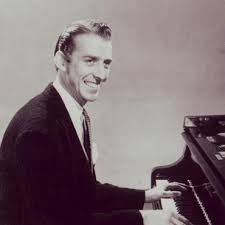 years continuing his private study of music, and beginning to use the natural leadership skills he had. These emerged quite early. In 1928, as a junior in high school, he founded a popular music sextet called the Bell-Tones. (The Kenton family lived in the Bell section of Los Angeles, and Stan went to Bell High School.) That same year, he sold his first musical arrangement. He was class president in his senior year. He graduated from Bell High School in 1930.
He did many small-time musical jobs in Los Angeles from high school graduation (spring 1930) until September 1931, when he first joined Everett Hoagland’s territory band at the Rendezvous Ballroom in Balboa. It is unclear how long he stayed on this first employment with Hoagland, but he was back at the Rendezvous with the same band after a hiatus for the summer 1933 season. By that time, the Hoagland ensemble had become the house band there. Kenton’s association this time lasted almost a year. In the 1935 summer dance season at the Rendezvous, the band there was led by clarinetist Russ Plummer. Kenton, along with many other Hoagland holdovers, joined the Plummer band. Among the other sidemen in this band were tenor saxophonist Vido Musso, and drummer Spike Jones.
years continuing his private study of music, and beginning to use the natural leadership skills he had. These emerged quite early. In 1928, as a junior in high school, he founded a popular music sextet called the Bell-Tones. (The Kenton family lived in the Bell section of Los Angeles, and Stan went to Bell High School.) That same year, he sold his first musical arrangement. He was class president in his senior year. He graduated from Bell High School in 1930.
He did many small-time musical jobs in Los Angeles from high school graduation (spring 1930) until September 1931, when he first joined Everett Hoagland’s territory band at the Rendezvous Ballroom in Balboa. It is unclear how long he stayed on this first employment with Hoagland, but he was back at the Rendezvous with the same band after a hiatus for the summer 1933 season. By that time, the Hoagland ensemble had become the house band there. Kenton’s association this time lasted almost a year. In the 1935 summer dance season at the Rendezvous, the band there was led by clarinetist Russ Plummer. Kenton, along with many other Hoagland holdovers, joined the Plummer band. Among the other sidemen in this band were tenor saxophonist Vido Musso, and drummer Spike Jones.

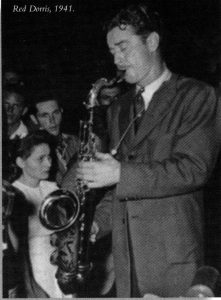 who could play an acceptable jazz chorus when that was required. Here he repeats the first two eight-bar segments of the main theme, and follows with the bridge, then the reeds and brass finish the first chorus. Note the use of “oo-wah” in the brass. This effect is created by the trumpet/trombone players either cupping their hands or using a small toilet plunger in front of the bell of their instruments, and “fanning,” with the “oo” effect being created when the cupping is near the bell, and the “wah” effect coming when the cupping is flexed away from the bell.
The tenor saxophone solo that comes next is played by Red Dorris (pictured at right), whose robust, big sound clearly was modeled on those of Coleman Hawkins, the “father” of the tenor saxophone (at least in the jazz world), and Vido Musso, one of Hawkins’s earliest and most forceful stylistic adherents, who was one of the best (though not well-remembered) early tenor saxophone swingers. Dorris undoubtedly heard Hawkins’s playing on records, while he most certainly heard Musso, a Los Angeles musician, in-person, and also probably on the records he made in 1936 and 1937 with Benny Goodman’s highly popular band. Despite a couple of minor intonation glitches, Dorris creates a very effective 16-bar jazz solo.
Following Dorris, the Kenton band itself shines, with excellent ensemble playing, effective use of dynamics, and a building, explosive finale.
This recording was digitally remastered by Mike Zirpolo.
Credits: https://swingandbeyond.com/2017/04/25/eager-beaver-1943-stan-kenton/
who could play an acceptable jazz chorus when that was required. Here he repeats the first two eight-bar segments of the main theme, and follows with the bridge, then the reeds and brass finish the first chorus. Note the use of “oo-wah” in the brass. This effect is created by the trumpet/trombone players either cupping their hands or using a small toilet plunger in front of the bell of their instruments, and “fanning,” with the “oo” effect being created when the cupping is near the bell, and the “wah” effect coming when the cupping is flexed away from the bell.
The tenor saxophone solo that comes next is played by Red Dorris (pictured at right), whose robust, big sound clearly was modeled on those of Coleman Hawkins, the “father” of the tenor saxophone (at least in the jazz world), and Vido Musso, one of Hawkins’s earliest and most forceful stylistic adherents, who was one of the best (though not well-remembered) early tenor saxophone swingers. Dorris undoubtedly heard Hawkins’s playing on records, while he most certainly heard Musso, a Los Angeles musician, in-person, and also probably on the records he made in 1936 and 1937 with Benny Goodman’s highly popular band. Despite a couple of minor intonation glitches, Dorris creates a very effective 16-bar jazz solo.
Following Dorris, the Kenton band itself shines, with excellent ensemble playing, effective use of dynamics, and a building, explosive finale.
This recording was digitally remastered by Mike Zirpolo.
Credits: https://swingandbeyond.com/2017/04/25/eager-beaver-1943-stan-kenton/